
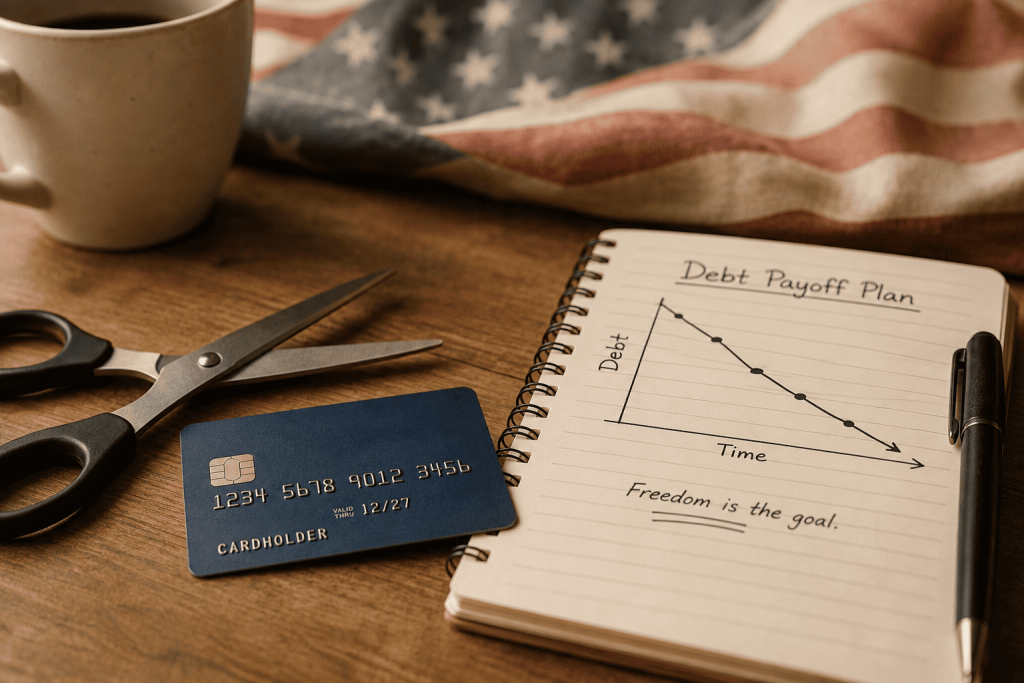
The average American credit card balance is now $6,501, and at a typical 17%-plus APR, that balance alone costs over $1,100 a year in interest before you pay down a single dollar of principal. Here’s a concrete, step-by-step plan to get rid of it.
Step 1: Know Your Real Numbers
List every card with its balance, APR, and minimum payment. Most people underestimate their total balance because they’re only looking at one card at a time. Add it all up in one place — this number is uncomfortable but necessary.
| APR | Annual Interest on $6,501 Balance |
|---|---|
| 29% (store cards, penalty APR) | ~$1,885 |
| 22% (typical card APR) | ~$1,430 |
| 17% (better-than-average APR) | ~$1,105 |
That table alone explains why the order you pay off debt in matters — a few percentage points of APR compounds into hundreds of dollars a year on a typical balance.
Step 2: Stop the Bleeding First
Before optimizing your payoff strategy, physically remove the card from your everyday spending — delete it from saved payment methods, take it out of your wallet, whatever works. You can’t out-pay ongoing new charges.
Step 3: Choose Your Payoff Method
The two standard approaches are the debt avalanche (highest interest rate first, saves the most money) and the debt snowball (smallest balance first, builds momentum). Either works — the one you’ll actually stick with beats the mathematically optimal one you abandon after two months.
If your balances are large enough, also look at:
- 0% APR balance transfer cards. Many offer 12-21 months with no interest, though most charge a 3-5% transfer fee upfront. Worth it if you can realistically pay off the balance within the promo window.
- Personal loan consolidation. A fixed-rate personal loan at a lower APR than your cards can simplify multiple payments into one and stop the compounding.
Step 4: Find Extra Payment Money
Two levers move the needle here: cutting recurring costs you don’t need, and adding income. A side hustle that brings in even $200-300 a month, applied entirely to your highest-priority debt, can cut months off your payoff timeline. Audit subscriptions and recurring “budget leaks” first — that money is often already in your account, just unassigned.
Step 5: Automate and Track
Set up automatic payments above the minimum, even a small fixed amount, so progress doesn’t depend on remembering. Track your total balance monthly, not just individual card balances — watching the combined number drop is what keeps most people motivated through the middle stretch, when progress feels slow.
Frequently Asked Questions
Should I pay off debt or build savings first?
Most guidance suggests a small starter emergency fund (around $500-$1,000) before aggressive debt payoff, so one surprise expense doesn’t put you right back on the card you’re trying to pay off.
Will closing a paid-off card hurt my credit score?
It can, since it reduces your total available credit and can raise your utilization ratio on remaining cards. Most people are better off keeping a paid-off card open and unused rather than closing it.
Is a balance transfer worth the fee?
Usually yes if you can pay off the transferred balance within the 0% promotional window. Run the math: compare the one-time transfer fee (typically 3-5%) against the interest you’d otherwise pay at your current APR over that same period.
This post is for general informational purposes and isn’t personalized financial advice.